
By Thom L. Jones for Gangsters Inc.
He was part of the Mafia before he was born. It was in his blood, or at least his father’s.
Rosario Marino Mannoia, is made into one of the oldest mob families in Palermo, based in Santa Maria del Gesu. His son, Francesco, will follow in his footsteps, like his brother, Agostino. Mafia men. Mafia killers. Working days spent in the biggest clan on the island of Sicily. Earning their bread by theft, extortion, and murder.
Francesco will grow into a man of honor, a killer, and someone with special skills that make him especially important to the bosses, until fate and the inevitable politics of Cosa Nostra drag him into a vortex of bad decision-making.

And one day, his mother, his sister, and his aunt will die because of this.
Women, children, and families are supposedly sacred ground the Mafia keeps clear of, although history has taught us otherwise. In the criminal underworld of Sicily, dominated by their brotherhoods, laws and procedures exist until they don’t.
Money trumps everything because it controls everything. Especially power. The men who run the kingdoms of crime in Sicily care little for protocol when their cash is at risk. Gangsters, hoodlums, mobsters — their definitions vary, although their destinations are intransigent. To be number one: the controller and the decider.
Those who cross them find out the hard way why death becomes them.
The catalyst, that triggers events leading to a night of carnage in a small town in Sicily is narcotics. Especially heroin, the currency of choice for criminals across the world in the 1960s. When the Mafia in Sicily discovered the drug, they were euphoric-they could not get enough of it.
Before drug trafficking took over the Italian mob, they had settled for the illegal importing of cigarettes from the mainland and their own labs to produce local content. The profits from heroin were a hundred times greater, although sourcing and distribution were much harder. Illegal packs of Marlboro’s were a domestic venture for Cosa Nostra. Heroin introduced them to a world marketplace, and they already had a network system in place through the cigarette business to help them on their way.
Within this international heroin network, the Sicilian Mafia bought the morphine base product from Asian countries such as Iran, Afghanistan, and Turkey and shipped the product to secret refining laboratories in Italy. And as they improved their systems, created their own within Sicily. After they refined the morphine base into heroin, the Mafia sent it to contacts in the United States, mainly through New York.
The success of this international heroin network scheme can be shown in an early 1980s investigation referred to as the Pizza Connection Case by congressional hearing witnesses and evidence before the Senate Caucus on International Narcotics Control, 100th Cong., First Session, 1987.
During the early 1980s, the Mafia of Sicily collected approximately $60 million ($300 million by today’s exchange) in proceeds from heroin sales in the United States. According to an FBI National Drug Strategy report, during the first half of the 1980s, a major source of such heroin imported into the United States was the Sicilian Mafia, which controlled not only the importation but also the distribution networks.
Their contacts in America included the Gambino brothers of Cherry Hill, New Jersey, a major criminal ring linked to their New York crime family connections.
Drugs are big business for the honored society. They could have been involved in their trans-Atlantic trade as early as 1977, and based on evidence of a Congressional Committee Report in 1984, following a visit to Italy of eight members of Congress, may have been connected to American sources as early as the 1920s when Sicilian Mafia groups began their cigarette smuggling ventures.
Francesco Marino Mannoia will be someone they need badly, who becomes really bad for the Mafia.
Born in 1951, in the Guadagna neighborhood in the city’s south, he starts life, after school, as a mechanic, and once inducted into the Mafia in 1975, works his way through mob training, becoming a specialist in the chemical process of converting morphine into heroin.
He will work under the guidance of Antonio Vernengo (the first Mafioso to establish a heroin refinery facility in Sicily in 1977), the uncle of his wife, Rosa, the daughter of Francesco’s capo (Boss of a unit within a mob family.)
Pietro Vernengo, known in the criminal underworld as “Bazooka Eyes” because of his terrifying stare, is the chief chemist and refiner for Stefano Bontate, the young chief of the family, who allows Francesco the chance to work for other bosses in Sicily eager to be part of the biggest money-making machine the mob has stumbled upon since they had discovered the joys of extortion in their formative days.

He converts for clan leaders such as Gerlando Alberti of Porta Nuova, Pippo Calo from the same clan, Antonino Rotolo of Pagliarelli, Stefano Bontate, and many others.
Francesco’s career as a Mafioso earns him a police record, la precedente, covering property crime, criminal conspiracy, Mafia association, and fugitive from justice status. He is also a suspect in 30 murders. His skill as a narcotics chemist gives him money and respect. A mob soldier with time under his belt, handling extortions, murders, drug deals, and prison. Serious, discreet, and reserved, in his Mafia culture, he had been educated in endurance and accepting adversity with dignity.
His philosophy on the art of murder is a classic insight into Mafia mentality:
“To strangle a man, especially if he is young and strong, you need three or four people; and the whole thing, contrary to what you see in films, lasts for some minutes, not a few seconds,” Mannoia once said. “It is very cruel and horrifying. By comparison, dissolving the body in acid is nothing, because by then the victim has ceased to suffer.”
Like most mobsters, people knew him by his nickname, “Mozzarella,” which referred to his passion for caprese salad, made with mozzarella and tomatoes.
Some sources claim he was the best heroin refiner in Cosa Nostra, extracting up to 98% pure product. He will work in drug kitchens across Sicily in Villagrazia, Piraineto, Chiavelli, Trabia, Belmonte Mezzagno, Carini, and Alcamo, refining over 1000 kilos of morphine into heroin, becoming so important to the Mafia that his skills save his life when the great Mafia war erupted.*
Following the murder of Stefano Bontate in April 1981, Francesco and then his brother, Agostino, born in 1966, will eventually join forces with Salvatore Riina, the Corleone boss, who is merging his Mafia clans into an unstoppable force that will be known as The Corleonesi, attacking their enemies in the Palermo region.

Informants will describe Riina as either a devil or a god. “He’s everywhere and nowhere; he hears everything,” they will claim.
A member of the anti-Mafia commission claimed, “The Corleonesi are an extremely military-minded group. They reject mediation and want to dictate terms, even when they are dealing with politicians.”
Francesco had been in prison during the war, after his arrest in December 1980, so he missed the carnage.
Wanting lots of money to finance his ambitions, Riina needs the revenue from drug production and welcomes Francesco as an ally to process the morphine he is importing. The brothers joined Riina. The other option was to die on some dark street or in a deadly countryside ambush.
Agostino, young as he is, made into the Mafia of Ciaculli at nineteen in 1985, became one of Riina’s deadly killers, a member of one of the fire-team groups that would lay waste across Palermo Province, destroying Riina’s enemies, mob, and state.
However, Francesco’s future decision-making choices will lead him into a valley of despair that will change the course of his life. Forever.
Escaping from prison in 1983 and becoming linked to the infamous Corse dei Mille Mafia, he was again arrested in 1985 by the Palermo Flying Squad while hiding in the apartment of his mistress, in Rome; he was sentenced at the end of December 1987 to 17 years at the great Maxi-Trial held in Palermo.
Since his induction into the Mafia in 1975, his actual time in the field is only about seven years or so, yet he crams a lot into it.
Held in Ucciardone Prison, down by the Palermo waterfront, he is then moved to Regina Coeli Prison in Rome, a building standing since 1654 and home to Italian criminals from 1902.
In April 1989, his brother Agostino vanished. His car, a Renault 5 registered to his sister, Vincenza, was found abandoned on a roadside, the exit route to Bagheria, in Casteldaccia, a chaotic urban development south of Bagheria. The front seat is covered in dried blood. They call it lupara bianca, white shotgun, a crime of refined savagery. Is the victim dead or just disappeared?
It was rumored he knew too much and was no longer trustworthy, and was one of six others linked to the Mafia who were found dead or went missing during the spring and early summer of this year: Antonio Aspetti, Antonio D’Onufrio, Francesco Bertolmi, and Antonio Mineo, the Mafia boss of Bagheria, along with his grandson, Gioacchino Mineo.
Some sources claimed these were victims of the losing side in the Mafia war, seeking revenge.
Like when the axe came into the forest, and the trees whispered, “The handle is one of us.”
However, Francesco knew it was the Corleonesi devouring their own, so he watched and waited in his prison cell on Via della Lungara.
In the autumn of 1989, his mistress, Rita Simoncini, approached the Antimafia Squad in Rome, offering to liaise between her partner, who wished to become a government witness, and Judge Falcone, the famous anti-mafia magistrate.
Although still officially married to Rosa Vernengo, Francesco had been involved with Simoncini for many years, the relationship producing a daughter.
Francesco knew that with his brother gone, he was living on borrowed time.
On October 8th, Marino Mannoia met with Giovanni Falcone and others.

“I’m tired and sick of belonging to Cosa Nostra,” he claims, “a membership that has caused me grave distress and a profound crisis of conscience. I’m not looking for a reduction in my sentence; I’ve realized I’ve made a grave mistake, and I want to talk. Of course, I don’t see any real commitment from the State against the Mafia, and that’s why, Dr. Falcone, I’ve decided to collaborate exclusively with you and Dr. De Gennaro (head of the Central Anti-Crime Unit in Palermo.)”
Over the weeks ahead, smoking three packs of Camels a day, his declaration will fill hundreds of pages of testimony during his interogation in the theatre of a high school in Rome. He became one of the most famous of the many pentiti, Mafia repentants, joining Team Italy.
He knows all the secrets and where the bodies lie. Like so many of his peers, he has an impressive memory for names, dates, and places for those who were dogged by death. Also, he is the first of the Corleonesi to reveal a full account of life within Cosa Nostra since the end of the Mafia War.
Tommaso Buscetta, until Manoia, the greatest source of intel on Cosa Nostra, had told magistrates in 1988 he was unwilling to open up about the Mafia and politics, “I have told you repeatedly that I would not discuss this until and if the time is ripe. It would be extremely foolish to discuss this subject—which is the crucial knot of the Mafia problem—while the very people whom we would be discussing remain fully active on the political scene.”
Francesco helps untie that knot. He is “disposto a parlare,” (ready to speak.)
Omerta, the oath of silence within the Mafia is dying and leaving it bleeding as men like Mannoia unburden themselves.
“As an institution, the Mafia as we have traditionally understood it is finished,” claims Colonel Domenico Di Petrillo, the Rome commander of a new national 1500 member anti-Mafia police force called DIA (Direzione Investigativa Antimafia) after its acronym in Italian. “It is not dead, but it has a lovely cancer.”

Mannoia’s testimony will be the first to confirm the links between the Mob and Rome, the crooked politicians, all the way up to the top; the corruption within Sicily’s government departments, among the police, and Italy’s secret service. It’s a festering swamp that to this day remains only partially drained.
And of course, the drugs.
“Buscetta and others have talked about how the drugs attracted new people and increased overall ferocity,” said Cesare de Simone, an Italian reporter who covers organized crime in Italy. “Internal discipline and the respect for territory disappeared. So did the point of honor which insisted that while you might have to kill a man, you’d never touch his wife or kids. Buscetta, who lost nearly everybody in his immediate family, talked about the ‘desert of death.’ The Mafia he joined was gone for good.”
Although in prison, Francesco could give Judge Falcone details of Mafia hit squads up to the spring of 1989. His brother Agostino had visited regularly, updating Francesco with the latest hits. He was, after all, part of some of these killing teams.
Another informant, Giovanni Drago, a member of the Brancaccio-Ciaculi Family, as was Mannoia at this time, claimed Totò Riina had learned that Francesco was talking to the government from his place in prison and was furious. He ordered that revenge be taken against any family members who were still in Palermo.

The impact of Francesco’s revelations creates tremors in the mafia world. This would explain the unprecedented, furious violence with which the Mafia responded: an “exemplary” execution, but also a warning addressed to the growing army of informants and their families.
In their strange world, if a mafioso becomes a tragiriaturi, one who provokes tragedies, and makes statements to law enforcement authorities, his life is forfeited; if he himself cannot be killed, punishment is carried out through a vendetta transversale (transversal revenge)—a retaliation based on kinship—on one or more of his relatives.
Such acts were an almost daily occurrence during the pentiti tsunami in the 1980s and 1990s, as dozens of Mafiosi began collaborating with the Italian justice department; it was usually male relatives who were killed, but they did not spare women and children.
What was to take place in a small town famous for its Baroque villas and coastal ambience, a 25-minute drive east from Palermo City, was retaliation so ferocious that it had no precedent in the Mafia’s bloody history.
The three women Francisco was closest to in his life, apart from Rita — his mother, sister, and aunt — disowned him as a scoundrel for his disgraceful choice to become an informant, no doubt to protect themselves.
It’s Thursday, November 22nd, 1989.
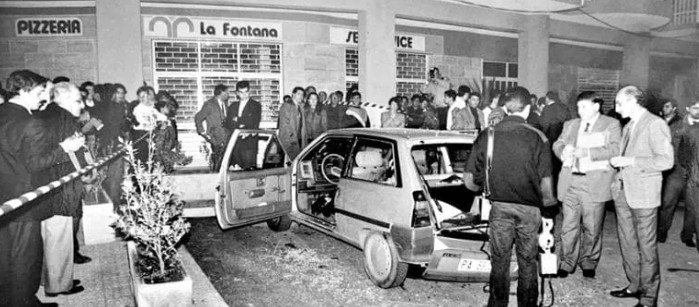
About nine-thirty in the evening, a white Citroen AX sits in front of a row of shops on Via de Spuches, in Bagheria. There are three women in the car: Leonada Constantino, 61, sitting in the passenger seat; her daughter, Vincenza, 24, is the driver, switching off the engine; and in the rear, Aunt Lucia Constantino, Leonada’s sister.
The women had left an apartment across the road, leaving Leonada’s husband, Rosario. He stand watching from a window.
Facing the car is a row of shops. The mother and daughter normally live at 91 Via di Mare in the Palermo suburb of Romagnolo, but have moved south as they are living a life of uncertainty: one son in prison, one missing, presumed dead, and the rumors spreading like a doomsday paper that Francesco has turned cop.
It’s dark, and now, deadly.
Out of the shadows, killers slide into place. The first moves to the rear of the vehicle. He is hefting a shotgun. His partner steps up to the driver, firing into the Citroen with a .38 revolver. Up close, he’s hammering death into the small car as fast as he can trigger-pull. The man behind the car blasts the rear window, blowing open Lucia’s head, turning white into red.

The fire-team vanished into the night.
Rosario Marino Mannoia, 65, who witnesses the massacre, rushes down to find a theatre of nightmare. When police arrive they find a man blinded by grief by the car filled with the dead.

L’Ora is the Palermo daily newspaper renowned for its war on the Mafia of Sicily, and its headlines the next day blare out:
“HORROR. Ferocious Beasts!”
A Mafia fire-team comprises six to eight men. All have pre-assigned jobs: organize transport, block any interference, and murder.
The revolver is wielded by Giuseppe Lucchese, the shotgun by either Giuseppe Graviano or Salvo Madonia. The rest of the team comprises Pietro Salerno, Francesco Tagliavia, Lorenzo Tinnirello, and Giovanni Drago. All made men, all from the Brancaccio Family, close allies of Salvatore Riina, except Madonia, who is part of the Resuttana clan, which is run by a close friend of the Corleone boss Riina, Francesco, father of Salvo.

Lucchese is a special kind of monster in a landscape overflowing with them.
A man who has already murdered two women in the previous six years, so this night is no sweat. He had killed his sister, Giuseppina, in 1983 for having an affair while married, and then his sister-in-law, Luisa Providenza Grippi, for going out with a man while her husband was in prison. He shot her dead in August 1987, in front of her 12- year-old daughter.
Like Marino Mannoia, he was born into the Mafia, almost literally. He came into the world and grew up on Viale dei Picciotti in the Settecannoli Quarter of the city**
Like many of his peers, he was small in stature, about five-six, and was nicknamed Lucchiseddu, “little Giuseppe.” He became obsessed with martial arts and was Italy’s kick-boxing champion in 1982 and 1983 when he was twenty-three.
His final known legal count is 50 murders, and he has been in prison for thirty-five years. So far.
In Mafia slang, a hitman who knows how to kill, the most ferocious, most cool-headed, is called “a runner.” Lucchese was one beyond compare.
A Mafioso can extort, steal, deal drugs, murder, and dissolve bodies in drums of acid. Still, he will not stand by while his dignity is subjected to a bit of family carnal jiggery-pokery. That’s just too much.
In their strange world of Mafiosità, men like Lucchese were so devious in their code of honor and conduct that they could find an angle in a circle.
When Gianni De Gennaio, a member of the Central Police in Rome, gave him the news of the massacre, Mannoia commented with incredible coolness: “It was to be expected, but I will not stop.”
The men of the fire-team that night of darkness in Bagheria are all in prison serving the harshest sentences, known as Article 41-bis***. Except Salerno. Released early from a life conviction in March 2025, he died soon after from natural causes.
Francesco Marino Madonia served 11 years (mostly in America) of his 17-year sentence and moved with his family to live in America under the protection of the US Marshals in 1990, where he gave evidence against the American Cosa Nostra. He testified in 1991 in the “Iron Tower” trial in New York involving the Gambino-Inzerillo-Spatola clan. He returned to Italy several times to testify in various trials.
His father, Rosario, moved with him to America. He had also testified before Falcone against the Mafia, following the massacre of his family in Bagheria.
Tommaso Buscetta and another significant former informant, Salvatore Contorno, a member of the same original Mafia family as Manoia, under Stefano Bontade, were also part of America’s Witness Protection Programme. Italy’s version was in its early stages in the early 1990s and was soon overwhelmed by the flood from the Mafia seeking sanctuary with the government. Mannoia had worked with the US Mafia on the eastern seaboard and was used by the judiciary to make cases against them.
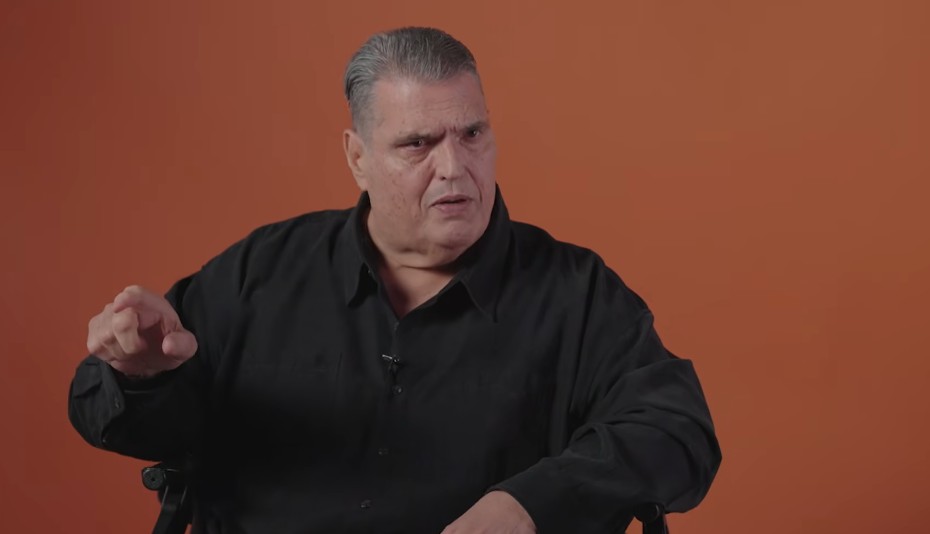
In 2011, Francesco and his family returned to Italy, and now live somewhere in a country that has probably never heard of him. At 75, his Mafia days, brief as they were, are a distant memory. All his principal enemies are dead or incarcerated. He knows, however, that the mob he was part of has a lasting memory.
Long after the events that fill this narrative, in Sicily, where the living close the eyes of the dead, and the dead open the eyes of the living, life continues its endless cycle, filled more with grief and sorrow than hope and renewal, in a land it seems the law forgot.
Scholars, historians, anthropologists, thousands of them, have wondered how the Mafia arose and, more importantly, survived through hundreds of years as Sicily emerged from its ancient history into the modern world.
In the end, a simple answer might exist for this complex question:
The ‘institutions’ are what Italians refer to as anyone who is an office holder: the police, the politicians, governmentalism in all its forms, the magistrates, and sometimes the Catholic Church. The institutions are what Italians recognise as weak and ineffective, and deplore as such. People speak of ‘those who command us from above,’ a phrase that reflects the almost universal perception that those in power do not care about those they regulate. Forcing people to confirm they have no faith in the state.
In Sicily and the rest of Italy, it has always been hereditary families against a weak state.
Somehow, the state always wins, and in the Mafia, memories are long, and death never takes a holiday.
*This story on Mob Corner is linked to many other accounts of Mafia events recorded here at Mob Corner. I recommend giving these a go:
A Killing in Palermo: A Triangle of Death
Behold a Pale Horse: The Killing of Boris Giuliano
Three Good Men: Life and death in Sicily fighting the Mafia
Secrets & Lies: Bringing down the Mafia and Italian State
** Picciotti is a Sicilian term for young men, often referring to low-ranking members or foot soldiers within the Mafia hierarchy. It stems from the Sicilian word for “boy” or “lad” and can also historically refer to members of Garibaldi’s army.
*** Article 41-bis of the Italian Prison Administration Act is a “hard prison” regime (carcere duro) designed to isolate inmates—primarily high-ranking mafia bosses and terrorism convicts—to prevent them from leading criminal organisations from jail. It entails strict isolation, severe restrictions on family visits and correspondence, and is often criticised by human rights groups. Source: Wikipedia 2
Sources:
Stille, Alexander. Excellent Cadavers. Random House. London, 1995.
Bolzoni, Attilio. White Shotgun. RCS Libri S.pa. A Milan, 2008.
Gambetta, Diego. The Sicilian Mafia. Harvard University Press. Cambridge, Mass., 1996.
M. Tumminello, F. Petruzzella, C. Ferrara, S. Miccich. Anagraphical relationships and crime specialization within Cosa Nostra. Procura della Repubblica presso il Tribunale di Palermo- Direzione Distrettuale Antimafia, Piazza V.E. Orlando, 1, 90138, Palermo, Italy 3 Dipartimento di Fisica e Chimica, Università degli Studi di Palermo, Viale delle Scienze, Ed. 18, 90128, Palermo, Italy. October 20, 2020.
Catino, Theresa M. Italian and American Cooperative Efforts to Reduce Heroin Italian and American Cooperative Efforts to Reduce Heroin Trafficking: A Role Model for the United States and Drug- Trafficking: A Role Model for the United States and Drug- Supplying Foreign Nations. Penn State Dickinson Law, Volume 8, Article 5. 1990.
Extracts from statements made by Francesco Marino Mannoia before the First Section of the Court of Assizes of Appeal on January 4, 1999.
La Repubblica. November 25th, 1989.
La Repubblica. December 6th, 1989.
L’Unita. November 24th, 1989.
L’Unita. December 5th, 1989.
L’Unita. November 15th 1990.
La Repubblica. February 3rd, 1994.
- Back to the Sicilian Mafia section or Thom L. Jones’ Mob Corner on Gangsters Inc.
- Check out the latest news on organized crime and the Mafia at our news section
- About Gangsters Inc.
Copyright © Thom L. Jones & Gangsters Inc.
Leave a Reply