
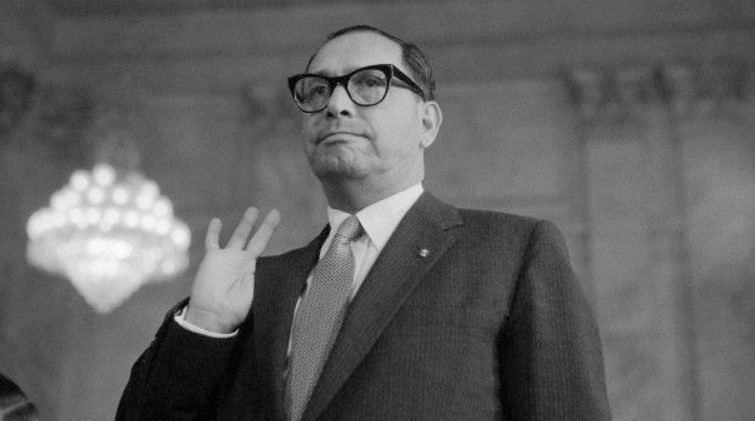
By David Amoruso for Gangsters Inc.
Gaetano “Tommy Three-Finger Brown” Lucchese built his power the old way: quietly, patiently, and with an accountant’s understanding of crime. By the time of his death in 1967, he had spent over four decades controlling the machinery of New York’s underworld, shaping labor rackets, transportation monopolies, and construction schemes that generated millions while keeping his name largely out of the press.

Lucchese was born on December 1, 1899, in Palermo, Sicily. His family immigrated to the United States when he was a child, settling in East Harlem, a breeding ground for early Italian street gangs. But rather than joining such a gang, Lucchese gave a legit job a try first. While employed in a machine shop, Lucchese lost most of his right index and middle fingers in an industrial accident. The injury left his hand visibly damaged, with only three fully functioning fingers.

Maimed, Lucchese decided a life of crime was all he had left. He threw himself into the underworld and joined the 107th Street gang. Here he became close to future kingpins like Charles “Lucky” Luciano, Gaetano Reina, and Frank Costello.
By his late teens, Lucchese was already involved in small-time theft, extortion, and had even been arrested for murder. In 1921, he was arrested and convicted for larceny and served 13 months at the infamous Sing Sing prison.
Forming the Five Families
Once released, Prohibition was in full swing. Lucchese officially aligned himself with mob boss Joe Masseria and became closely associated with Gaetano Gagliano and Charles Luciano. The Castellammarese War proved to be a turning point for the American Mafia and would help Lucchese become more powerful. Rather than support his boss Masseria for his fight for supremacy against Salvatore Maranzano, Lucchese sided with Luciano against the old-guard Mafia leaders. When the war ended with both men dead — Masseria in April 1931 and Maranzano in September — Lucchese emerged on the winning side with some serious clout.

Luciano’s reorganization of the Mafia into the Five Families elevated Gagliano to official boss status, with Lucchese named as his underboss. From that moment on, Lucchese became the operational backbone of the Gagliano family.
Cementing his criminal empire
Throughout the 1930s and 1940s, Lucchese focused heavily on labor racketeering. He gained influence over the International Ladies’ Garment Workers’ Union, trucking locals tied to the waterfront and garment district, and later construction unions across New York City. The family specialized in bid-rigging, kickbacks, and extortion schemes that forced businesses to use Mafia-controlled labor or transportation.
Lucchese’s reach expanded significantly during World War II and the postwar construction boom. By the late 1940s, his family had major interests in trucking companies servicing the garment district, airport freight at Idlewild (later JFK), and concrete and steel supply chains feeding New York’s rapid expansion. These operations generated steady income and gave Lucchese leverage over legitimate businessmen who preferred cooperation to disruption.

When Gagliano died of natural causes in February 1951, Lucchese succeeded him without incident. The lack of internal conflict was telling. Lucchese had already been running much of the family’s affairs for years, and his promotion merely formalized an existing power structure. The family would later become known as the Lucchese crime family, cementing his status among the Mafia elite.
“A capable and influential Mafia leader”
As boss, Lucchese deepened his alliance with Carlo Gambino, an underboss who became head of the Gambino family in 1957. Their bond would become familial in 1962 when Lucchese’s daughter, Frances would marry Gambino’s son Thomas.

The two men shared a conservative philosophy: avoid unnecessary violence, prioritize earnings, and keep the Commission stable. This partnership proved crucial during turbulent moments, including the infamous Apalachin meeting on November 14, 1957, when dozens of Mafia leaders were arrested in upstate New York. While the gathering drew national attention to organized crime, Lucchese himself avoided arrest and weathered the fallout with minimal damage.
In the late 1950s and early 1960s, Lucchese’s family expanded its construction rackets, infiltrating unions connected to major public works projects. These included highway construction, housing developments, and commercial buildings across New York City and Long Island. Kickbacks were extracted at every stage, from labor contracts to material deliveries. Federal investigators later estimated that Mafia-controlled construction rackets during this period siphoned millions of dollars annually.
Despite his power, Lucchese maintained a low personal profile, living a leisurely life at his home in Lido Beach, Long Island. Compared to the repeated indictments faced by other bosses, Lucchese remained remarkably insulated. Authorities described him as: “A capable and influential Mafia leader who has developed powerful friends in political circles and has used them at times on behalf of his Mafia associates.”
By 1966, Lucchese’s health began to fail. Diagnosed with a brain tumor, he gradually withdrew from daily operations. He died at home on July 13, 1967, at age 67. His death did not spark immediate violence or upheaval, a final reflection of the disciplined organization he left behind.
He was eventually succeeded by capo Carmine Tramunti as temporary acting boss until Antonio “Tony Ducks” Corallo was released from prison and would take over and lead the family in the years to come.
- Back to the Lucchese Family section on Gangsters Inc.
- Check out the latest news on organized crime and the Mafia at our news section
- About Gangsters Inc.
Copyright © Gangsters Inc.


Leave a Reply