
By Thom L. Jones for Gangsters Inc.
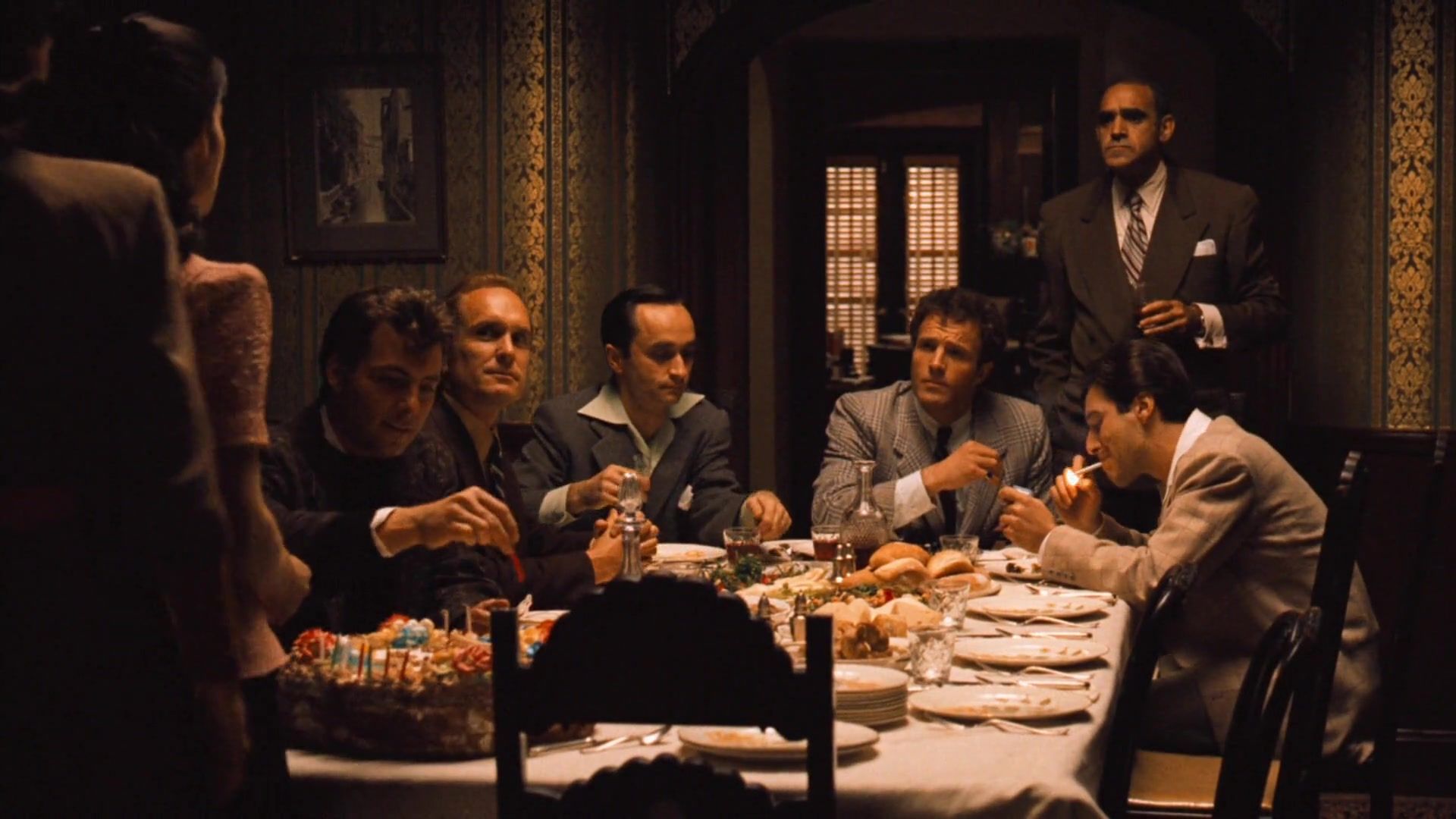
Somehow, it always circles back to that movie. The one Coppola created back in the early 1970s, The Godfather.
There’s the scene with Clemenza, the family’s skipper, whose is tasked with getting rid of a someone: a guy called Paulie Gatto who had betrayed godfather, Don Corleone, the big boss-man. Like all good Mafia hits, the killers are always a goombah, an amico, someone you trust. Clemenza gets Gatto to drive around New York looking for something. Rocco Lampone, who is tight with Gatto comes along for the ride, in the back seat.
In the middle of nowhere, they pull over while Clemenza gets out to take a leak. There’s three gunshots, and the jobs is done. The skipper tells Rocco, the hitter, “Leave the gun, take the cannolis,” and they walk away from the blood-spattered car, to fight another day. Clutching their box of pastries, a Sicilian delicacy of ricotta and candied fruit.
Eating with the Mafia can often be a dangerous and deadly encounter. Food and death share an uneasy alliance at times among men where looks mean more than words and gestures sometimes say everything. Even when pointing at the pasta. The excess of food runs parallel to the excess of violence. There is no distance between the meat and the blood, a bargain struck with winner taking all.
In the United States, gangsters have been blown away either eating, or going to eat or just relaxing with a cigar after a meal. Soft food and hard lead seem as American dead as apple pie and ice cream. And Cosa Nostra has always been behind the scenes when it comes to food feeding the American Public. Martin Parker claimed:
“In the 1980s, supplies for pizza manufacture in the USA were controlled by Joe Bonanno’s ‘Grande Cheese’ company; the Falcone brothers’ ‘King of Pizza’ chain; Carlo Gambino’s ‘Ferro Cheese’; Louis Piancone’s ‘Roma Foods’; Michael Piancone’s ‘Pizza Palaces’, with its associated ‘Caribbean Management Corporation’ which was based in the Grand Cayman Islands, and so on.” *
Joe Masseria, a big Mafia boss in the early days of New York’s Italian underworld, went for lunch in April 1931, to a seedy little restaurant in a seedy little street on Coney Island, and ended up with bullets for desert. Except, he apparently never got around to the eating part of his luncheon appointment. The myth is that he ate mountains of pasta and lobster as part of a seven course meal. His autopsy showed he had lots of nothing in his stomach, except some liquid goo.

Forty-one years later, in April 1972, another mob boss finds food and violence and sudden death an irresistible combination.
Joey Gallo was a wild card in a floating deck of wannabe gangsters linked into the Mafia clan ran in South Brooklyn by Giuseppe Profaci. A pseudo psychopathic schizophrenic, his response to most problems was “Fuck You.” Believing he was short-changed by the big boss, he began making waves, ignoring the basic rules of physics that energy cannot be created or destroyed but only transferred. In his case, it would be from life to death.

On April 6th, Joey, his wife and her daughter, plus friends, went on the town and ended up in the early hours of the morning at a clam restaurant in Mulberry Street, deep in the then Little Italy of Downtown Manhattan.
Around 5am, one, two or three men entered the restaurant and fired a total of fifteen shots, some of which eventually hit the target, Joey, who subsequently died in hospital of his wounds. His last super was either misplaced dinner or very early breakfast.
Seven years later, another mob boss, again in New York, arranged to meet up with some associates for lunch, again in Brooklyn.
Carmine Galante, a short, thickset thug of an underboss, runs the drug trade for the Bonanno Mafia Family, based in Williamsburg. A man who had been killing people since he was big enough to hold a pistol; a clenched fist with a bald head, he arranges to meet two men for lunch on a hot July day in 1979.

Galante had been released from prison, in Michigan, where he was serving a sentence for parole violation, in March of that year, and was working furiously to rebuild his place in the Bonanno Family. He was lunching with his cousin, Joe Turano, owner of “Joe and Mary’s” restaurant on Knickerbocker Avenue, and Leonardo Coppola, a close associate of Galante; a skipper, or crew chief in the family. Both men were in dispute over some slight involving Joe’s wife, and Galante wanted it sorted, before his cousin left later that day on an overseas trip.
No one went anywhere, except the great beyond.
The men were sitting outside on the patio, under a sun umbrella, enjoying coffee after a meal of fish and salad, along with a jug of dago red wine. Also sitting with them, were Galante’s bodyguards: Baldo Amato and Cesare Bonventre- cousins from the same small town in Sicily- Castellammare del Golfo.
At 2.45 pm, three masked men hustled into the restaurant and gunned down Galante, Turano and Coppola. The two bodyguards, impotent by design, dressed in black leather jackets and dark jeans, in spite of the 90 degree temperature on this day, slithered out along with the gunmen, like seals, looking for a place to hide. Bonventre would end up in pieces one day, stuffed into drums of glue and Baldo is living the good life forever, in a prison cell in Fort Lauderdale.
And then there was Paul Castellano.
Boss of the Gambino Family, his early dinner appointment with a group of mobsters at Sparks, a trendy and very expensive steak house in Mid-Town Manhattan, ends before it begins; food, the purveyor of life sometimes in a kind of antonym, marshals mobsters and hoodlums into the darkness of death.

Castellano is trying to quell a mutiny within the crime family lead by John Gotti, a Queen’s-based crew skipper, who like Oscar Wilde, realized that ambition is the last refuge of failure. So made sure he avoided that pitfall, by organizing an ambitious hit to take place in broad twilight at 5.30 on the afternoon of December 16th, 1985.
As the big boss began to exit his expensive limousine, and his driver come bodyguard come underboss, Tommy Bilotti, started to climb out on the street side, three gunmen stepped up and blasted each man multiple times. Tommy ended up spread-eagled in the glow of passing traffic, a classic “Why me?’ position, and Paul collapsed half in, half out, onto the pavement, perhaps catching a last whiff of medium rare fillet mignon to help him on his way.
The hit, orchestrated by Gotti and his number two, Sammy Gravano, paved the way for a new kind of stewardship in a Mafia clan that had a disturbing record of leaders lost to the gun. Castellano being the fifth to die this way since the first, Salvatore D’Aquila, went down in a hailstorm of lead outside a Manhattan pharmacist in 1928.

There would be one more, on March 13th, 2019: Francesco Cali, although he drowned in bullets fired by a deranged believer in cults and necromancy. No restaurants in sight.
There were many more gangsters across America who combined their last meal with their last day, although these are the ones best remembered. New York, being America’s biggest metropolis, it’s understandable the major hits in gangland went down across this city. The one with five Mafia families, competing for the spoils, the one with thousands of criminals linked in through made-men and associates.
Chasing the dream and killing the nightmares.
Then, there is Sicily………..
In the home of the Mafia, the place where it originated, the link between food as a social connector and the secret society, goes back decades, generations, eons, as long as the organization does.
No one knows just when and how it emerged.
There is a report in 1838 from Pietro Calà Ulloa, a Bourbon official in Sicily, referring to criminals who fit “The Mafia Profile.” This is thirty years before the term is generally considered to have appeared in print in Italy. It’s almost certain this criminal group had existed in some form long before Ulloa discovered it.
One Mafia boss, Leonardo Messina, claimed in the 1990s that his mob ancestry dated back 200 years, and “Cosa Nostra likes to trace itself back to the Apostle Peter.”
As early as the 1820s there is an organization referred to as “Sacra Unione,” operating in the villages of Mazzarino, Aidone, Barrafranca, Mussomeli, Delia and Butera across the provinces of Etna and Caltanissetta, made of about 40 men who were campieri (herdsmen), gabellotti (lease-holders), at least two priests, (one of who is the alleged leader) a judge and several local politicians. They seem donkey-deep in cattle rustling, extortion, kidnappings and murder.
In 1900, Armando Sangiorgi, police chief of Palermo created a report, two years in the making, providing a comprehensive picture of mafia criminality in the areas surrounding Palermo through information derived largely from informants.
“Like other parts of this and nearby provinces,” Sangiorgi stated, “the Palermitan countryside is oppressed by a large association of malfattori, organized into branches, divided into groups; every group is regulated by a chief and this union of criminals has a supreme chief.”
According to his report, the cosche (the way they referred to each clan,) had precise, formalized rules and an administrative staff whose positions clearly resemble those described by Mafia informants a hundred years later.
The associates regularly paid a membership fee, assembled in meetings, and took the most important decisions involving group affairs jointly. About 216 men were reported as initiated members of this coalition. According to an estimate attributed to Francesco Siino, allegedly the supreme chief, until 1896, the overall number of people involved was around 670, if the so-called cagnolazzi (those operating as associates who that had not undergone a formal ritual of affiliation) were also taken into account.
Fifty-six years later, they were still at it. In 1946, Amedeo Brance, head of the Carabinieri (Military Police) in Palermo wrote a report, part of which claimed:
“The mafia, a hidden inter-provincial organization, with secret tentacles that appear in all social classes, having as its exclusive aim unlawful enrichment at the expense of
honest and defenseless people, has rebuilt its cells or ‘families’, as they are called here in slang, in particular in the provinces of Palermo, Trapani, Caltanissetta, Enna and Agrigento. The mafia, as had happened before Fascism came to power, has already succeeded in imposing supervisors and employees of its own liking on landowners, in granting lands or farms to rent at a good price to its affiliated members, in influencing public life with violence, interfering not only with the activity of single private persons, but trying to oppose the workers recent gains with threats and violence towards trade union officials and leaders.”
These gangs, that had terrorized a state of Italy, since before the country had formed, would meet from time to time to mix and mingle and talk and eat in great feasts they called grandi schiticchiate, the principal occasion for socializing in Cosa Nostra. A ritual, based on the Mafia’s origins in the countryside of Sicily.
In rural areas they would entertain in isolated farms and in cities, in “safe” restaurants or buildings they controlled. The meals would usually begin in the late afternoon, and finish around midnight.
These were the times when they stopped la puliziata di pedi, “washing their feet,” a Mafia synonym for killing, and washed their hands instead, before preparing their food.
Among the rural Mafia, boiled sheep was the preferred centerpiece of the table. In urban-land it would be pasta, fish and meat and vegetables and lots of gelato and pastries.
The boiled lamb, popular with shepherds, who many claim as the building block DNA of the Sicilian Mafia, takes a long time to prepare, deliberately designed to encourage socializing and endless meetings around a large cauldron, using water, heavily aromatized with herbs. This has to be changed three times, the third pot will be the soup that is served before the main meal of mutton is served.
Sometimes these banquets would end in general bacchanalia, what the Mafia call baldoria, with the diners throwing food and drink, plates and glasses at each other. Peter and Jane Schneider, famous American anthropologists who studied the Mafia for years, living among them, believed these grand feasts nurtured an aura of exclusivity among those present insulating them from “ordinary” people, confirming that Cosa Nostra were the elite of the criminal world.
Gian Carlo Caseli, a former magistrate, in his history of Sicily, La Vera Storia d’Italia, claims the killings of two powerful Mafia leaders, Stefano Bontade and Salvatore Inzerillo in 1981, marked a turning point in the history of Cosa Nostra, and affected the entire future of the organization and its strategies. They represented the change from a situation of hidden conflict inside a pluralistic organization, governed by democratic rules, to a strategy for the conquest of absolute power by the Corleonesi, the gangs gathered under the chairmanship of Salvatore Riina, who would transform Cosa Nostrainto a dictatorship, no longer founded on consensus but terror alone, within the organization and toward society and the state.**

According to the evidence of government informants, Riina and his closest circle would plan their campaign against their enemies during these festivities. The serious stuff being resolved before they all got drunk.
There was one such feast in a farmhouse in the hills above San Giuseppe Jato that occurred during the Mafia War of the early 1980s. It happened on November 30th 1982 and when it was over, no dishes were broken, only bodies.
Among the clans Riina encouraged into his conspiracy was one north of the Palermo city center. This territory covered Mondello, Partanna, San Lorenzo and Aquasanta and was run by Rosario “Saro” Riccobono, nickname ‘The Terrorist,” for his ruthless and unscrupulous behavior.
The name, u terrorista, is given him by Giuseppe Calo the boss of the Porta Nuova clan, who will be arrested in 1985 and imprisoned for life on multiple charges. He is still serving his sentence at the age of 95.
At age fifty-three Riccobono was a major drug trafficker, mob boss, killer, and a man of uncertain future. The war Riina had created was not only killing men, it was destroying trust, loyalty and creating confusion on a scale unseen in an organization that seemingly never knew what right and left hands were doing other than endlessly avoiding each other.

Saro was a member of the Mafia cupola, its board of directors, one of eleven. Michele Greco was chairman. He would have plenty to say about The Godfather movie some years down the track in an interesting interpretation of how “bad” the Mafia of fiction was compared to the real thing.
Salvatore Riina was not a member of the management group at this time. Bernardo Brusca, the Mafia boss of San Giuseppe Jato was. Bernardo and Riina were tighter than a submarine’s door. Greco was in Rinna’s pocket and definitely the wrong man to turn to and trust. Saro did both and then learned the hard way. Mafia politics is no place for old men.
Following the murder of Bontade, five of his top men were led into a trap manipulated by Riccobono, who invited them to a mangiata, a feast, but instead lead them to a warehouse in San Lorenzo where a neck tie party awaited them. This was Saro’s way of showing the Corleonesi his treachery credentials.
Riina nodded his approval and then planned the end of Riccobono. A traitor once, is a traitor always. Consolidating his power, the boss of Mondello was becoming an inconvenience, and possibly a dangerous one at that. And the little guy from Corleone already had someone in mind to run the Mondello Family: Giuseppe Giacomo Gambino.
A man who would become Riina’s shadow, complicit in crimes galore, and one day down the line, would hang himself in a prison hospitals on the mainland.
Despite his initial support for the Corleonesi, Riccobono became an unreliable figure in the realm of Riina: too autonomous, too locked into uncertain political viewpoints, too dangerous.
Riina decided to act against him when he had created enough strength and support against his main adversaries. Also, he had never managed to infiltrate his own men into Riccobono’s district, making him an even greater potential threat.
Saro attempted to maintain a neutral stance, relying on the protection of Michele Greco, the formal head of the Commission, who unfortunately for him, secretly backed Riina.
It is sorted on this grey, miserable Tuesday, rain falling in drizzle across the countryside.
Riccobono arrives at a farmhouse in Dammusi, about three kilometers north of San Giuseppe Jato. He brings along three associates: Salvatore Micalizzi, Vincenzo Cannella and Carlo Savoca. They arrive in their cars, a Volvo, Volkswagen Golf and a Mini Minor. It’s eleven in the morning. A long day ahead.
Invited by Riina to lunch, they walk into a nightmare. Not so much “Midnight in the garden of Good and Evil,” more a Sicilian version of “Bleak House.” ***
The events that unfold here have never been catalogued by the police because they did not become public until a Mafia informant disclosed details in the autumn of 1989. Francesco Marino Manoia was a close confidant to Riina and the first of the Corleonesi to turn and become a pentito, a penitent or informer, and the first to open the books on what happened to Riccobono et al.
Manoia will become one of at least seven, who, over the years ahead, will describe what happened that day in the country. Three of them, Baldassare Di Maggio, Giovanni Brusca (son of Bernardo) and Giuseppe Maniscalco, are also part of the killing team bringing Saro’s dreams to an end.

What happens is a confusing narrative filled with truths, half-truths, and not quite damn lies.
Every account claims events take place at a farm house- type building owned by Bernardo Brusca. He in fact, lived with his family on Via Falde in San Giuseppe Jato. The building almost certainly belonged to a local doctor who rented it to Brusca.
The myth is that the four guests that day, ate a great meal and then sated with food, so many courses, so much wine, and fully relaxed, were murder by strangulation, a standard Mafia killing method. Maniscalco claimed in his testimony that aided by Giovanni Brusca, he garroted Riccobono. It has been claimed and repeated often that as he dies, Riina leans into him and whispers, “”Saro, this is where your story ends.” It’s Shakespearean in its delivery, but probably never uttered.

In another room, his three aids met the same fate. Maniscalco never mentions food. The number of killers varies according to who is telling the story but almost certainly consisted of at least:
Bernardo Brusca and his son Giovanni, Salvatore Riina, Giuseppe Giacomo Gambino, Antonio Madonia, Pino ‘Scarpuzzedda’ Greco, Giuseppe Maniscalco, Baldassare Di Maggio (who also lived on Via Falde at number 32,) Calogero Ganci and Giuseppe Agrigento.
Every one of them a seasoned killer. Men who had their eyes opened, as mafiosi would say. Brusca junior would later admit he had killed between 100 and 200 people but couldn’t remember exactly how many. Greco, was a mad-dog exterminator with a tally never confirmed, but lots. A distant relative of Michele Greco, a man so devoid of humanity, his own father had disowned him as he lay dying.

There is a lot of activity through the day. After the killings, the bodies have to be disposed of. The dead men’s cars are driven off and left in the overnight parking at Palermo’s International Airport, fifty kilometers to the north.
Baldassare De Maggio had collected containers of acid, 200 liter drums, from a garage in Jato in the early hours and delivered them to I Dammusi, and they stripped the dead and dissolved them in the drums before pouring the sludge into a nearby stream, that was now over flowing because of the rain, causing all sorts of complications. Picture the scene: naked dead bodies everywhere, people milling about, huge containers of deadly acid waiting to destroy anything they touch. And it’s raining.
And in a final hurrah that day, they kill someone else.
Across in Palermo, death was not taking a holiday, as Saro’s tight group in Mondello were wiped off the face of the earth. Allegedly mostly killed at the estate of Michele Greco in Ciaculli after their very own mangiata. One victim, Saro’s brother Vito, was found in his car near a police station in the city. At least his head was. Three were gunned down in the Singapore Two Bar on Via Marmora in town: Vicenzo Cannella, the owner, and his brothers, Domenico and Filippo, by a hit team of three including Pino Greco, who was filling a busy schedule of killing on this afternoon.. And that was that. Only three survived. How many died we don’t know for sure. Between twenty and forty seems the best calculated guess.
Two of the survivors had at times, been close to Riina in the old days, both acting has his driver. Gaspare Mutolo, Saro’s number two and Salvatore Lo Piccolo, a soldier, who lived to become the big boss of the clan based in Tommaso Natale and came close to being the successor to Riina until the law decided otherwise when it arrested him and his son in November, 2007. The third lucky man that day Michele Micalizzi, is the son-in-law of Riccobono. He’s still around after many years in prison, and an arrest file as thick as the Bible.
The fifth victim in the country side that last day of November was Salvatore Scaglione, the boss of Noce on the borders of Uditore, for almost ten years. He was known in the underground as U Puglista, the boxer. It didn’t help him that afternoon in Dammusi.
Scaglione had been a supporter of Bontade and Inzerillo, and Riina never forgot that. Tommaso Buscetta the Mafia government informer, who disclosed more about the Mafia to Giovanni Falcone and other magistrates than anyone before or after, claimed Riina had the “memory of an elephant” and never forgot anything, recalling actual words and phrases from years before. He also wanted to enfold Noce as a family into his Corleonesi, helping to establish himself as a hegemonic power, leveraging this through his control of the cupola.
As Scaglione walked into his trap, believing he had been invited to the house for a meal to discuss policy with Riina, he would have known it was all over. Begging for his life, he was quickly subdued, strangled to death and then went the way of the acid bath and by now, the heavily polluted stream.

In a move of sublime irony, six years after his murder, Rosario Riccobono, thought to be on the run, was sentenced to life in prison for Mafia crimes at the great trial in Palermo.
After Dammusi, Salvatore Riina had two more years to consolidate, merge, absorb and reconstitute the clans of Sicily’s Mafia into his own thing, as he began his war against the state, to bring it to heel. He almost got there, but not quite. Along the way, bodies fall like leaves in a storm, families, both biological and criminal endure endless fractures and the Italian senate, as usual, drifts impotent, under the weight of its corrupt and inept stewardship.
Almost a quarter of a century after the events at I Dammusi, another Mafia boss, goes for a meal and instead finds endless sleep.
Bartolomeo Spatola is the boss of Tommaso Natale. At 72, he’s old, frail, suffering from asthma and other chest problems. He runs a mob family in a key mandemento, a Mafia district, to the north and west of Palermo central. He answers to Salvatore Lo Piccolo, the same one who survived the 1982 purge, who came to believed Spatola had betrayed him and had to go.
On 18th September 2006, the old man, carrying a rabbit dressed to eat, and a bottle of whisky, his contribution to the forthcoming mangiata, is picked up by Antonino Pipitone and driven to an abandoned house in the countryside near Giardinello.
Waiting there is Sandro Lo Piccolo, son of Salvatore and Andrea Adamo. Spatola, anticipating a sit-down based around a meal, is surprised to find he is simply an easy victim to a garroting by Adamo. They bury him in a basement of a house in Villagrazia di Carina. It’s a long, endless day, travelling over and around mountains and across plains, from pick-up to transit death house to burial destination.
What makes this episode intriguing is that he had already been murdered earlier. Or almost.
A month before Spatola died for his lunch, a retired tavern owner called Giuseppe D’Amico, who bore a string resemblance to Spatola, was shot dead near a greengrocer, that Spatola often used. Two men on a Triumph motorbike flashed by, and the pillion passenger, Gaspare Di Maggio, blasted the unfortunate man to death. Everyone thought this was the start of another Mafia war when in fact it was two killers on a bike that picked the wrong man. The fickle finger of fate working overtime.
This story begins with a reference to the film, The Godfather, and so is how it ends.
Michele Greco is a man linked into the history and structure of the Mafia as no other.
The son of Piddu, known as il Tenente, the lieutenant, he is part of a family dynasty going back generations emerging as a pillar of Sicilian organized crime; as royalty as it gets. Most people forget that Riina, and his aides, Bernardo Provenzano and Leoluca Bagarella, were first generation men of honor. Although they become infamous as the drivers of the Corleonesi, compared to Greco they were bus drivers to his royal carriage position controlling a mob legacy dating back into the 19th century.

Greco is based at La Faveralla an estate in Ciaculli which became a meeting point over the years for Mafia clans, and others. He invited the city’s powerful to his estate in the south-east of Palermo, and was famous for his hunting parties that everyone attended: princes and counts, politicians, judges and even police chiefs and carabinieri big-wigs. In the 1950s, Emanuele Pili, General Prosecutor of Palermo, would often accept hunting invitations to the estate.
Like a benign country squire, Il Papa, the Pope, as he became known, would host lavish mangiata e parlata where guests would feast on grill-roasted artichokes and lamb, caponata, peperonate, pecorino with red peppercorns, mandarins, casata and cannolis. Just like the ones Rocco carried away after killing Paulie Gatto.
He headed the Mafia cupola for a number of years, and although many sources claim he was a puppet of Riina, he was a crafty, controlling politician of a Mafioso rather than a violent killer-type, although he was convicted on December 16th 1987 of masterminding 78 murders during the Mafia war of the early 1980s.
According to Buscetta, Greco reigned but did not govern.
Arrested and tried during the great Maxi-Trial of 1986/87, he was held in cell number 22 within the courtroom for the duration of the court case; often seen sitting and smoking a pipe, a man who seemed confused to be there. Almost a disinterested observer of the biggest trial against the Mafia, ever.
In one of his many court appearances, he testified about a Mafia informant, Salvatore Contorno, “If he had seen Moses (the film) and not The Godfather for example, he wouldn’t have slandered me, and that’s the truth.” He went on to claim, “Those who repent are failed criminals, who exist to tell falsehoods. Like Contorno who has seen The Godfather, I am outside of everything.”
Fact and fiction are often unstable empirical terms when examining the Mafia in the context of its relationship to food and its place in their social assemblies. Food, delinquents and violence, link themselves into Mafia lore like The Three Wise Men in Jerusalem searching for an answer, and simply discovering an even bigger mystery.
References for the story are sourced from newspaper articles, web-sites, court documents and many books. The complexity of Mafia politics in Sicily is mind-numbing and tracing the links, lineage and activities of Mafia families is at times, like stumbling, blindfold through a maze made of tripe.
* Eating with the Mafia. Martin Parker. http://www.sagepublications.com 2008.
**The True History of Italy. Interrogations, Testimonies, Evidence, Analysis. Giancarlo Caselli and His Deputies Reconstruct the Last Twenty Years of Italian History , Naples, Pironti, 1995.ISBN 88-7937-146-0 .
*** Midnight in the garden of Good and Evil is a novel by John Berendt. Bleak House is one of the famous books written by Charles Dickens.
- Back to the Sicilian Mafia section or Thom L. Jones’ Mob Corner on Gangsters Inc.
- Check out the latest news on organized crime and the Mafia at our news section
- About Gangsters Inc.
Copyright © Thom L. Jones & Gangsters Inc.
Leave a Reply