
We’ve almost made it,
We’ve almost made it to the top.
Randy Newman
By Thom L. Jones for Gangsters Inc.
Naples, Italy, was where they emerged. From the teeming slums of Scampia and Quartieri Spagnoli, places that fed the Camorra an endless stream of recruits.
Youngsters clamoring to be part of a life that could only ever lead to death.
Camorra is one of the five major Mafia-type secret criminal societies, some of which have existed in Italy for perhaps hundreds of years. This one, based in Naples and the surrounds of Campania, is a clan-based organization that some believe originated in Spain in the 15th century.
More horizontal-structured and less unified than Cosa Nostra of Sicily, the myriad clans that make up its mass, operate like a swirling whirlpool of criminal activity running extortion rings, controlling prostitution, managing waste-disposal scams, burglary rings, racketeering, illegal arms control, supervising pick-pocketing, mugging and bag-snatching gangs, controlling construction and public sector contracts and drugs. Always drugs.
Over 100 clans and perhaps up to 10,000 members and associates. A universe of criminal energy powered by protons and neutrons of evil, generating billions of dollars of illegal revenue, year after year.
Needing more and more recruits, they turn to paranze, a plural word that transforms from the fishing field, and becomes the new layer cake of Camorra’s mobs as children and teenagers move into organized crime, not just as peripheral crumbs, but a crucial ingredient.*
Business on the streets of Naples and Palermo will never be the same as this trend migrates from mainland Italy to an island in the sun that has lived with Mafia terror since before Italy became a country.
Roberto Saviano wrote about the emergence of this faction and the way it has shifted the dynamics of organized crime in Naples back in 2016 in his novel-La Paranza Dei Bambini. **
Paranze are small fishing boats operating in the Tyrrhenian Sea off the west coast of Italy, but in the slang of Camorra lingo the word refers to the criminal gangs run by youngsters- the small fish. The original meaning of the word shows that boys and youths are deceptively lured into a life of crime, just as light lures fish into nets.
Unlike the old regime of Italian mobsters, who respected rules, especially their code of omertà, the oath of silence, this new breed of killer-kids is a fish of a different kettle, big or small.
Some sources refer to them as the Google Gang of Gomorrah.***
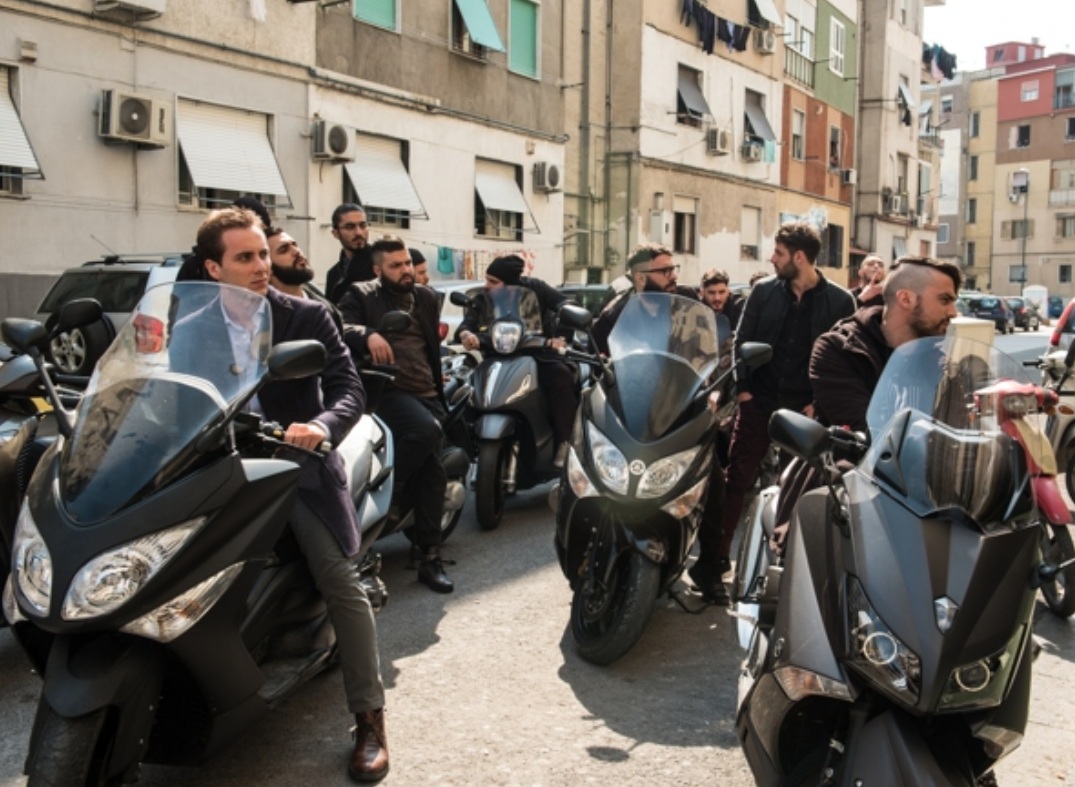
They shout aloud who they are on social media. Dressed to attract attention, swigging from $300 bottles of champagne as they swagger through the streets, screaming along alleys on their scooters like packs of hyenas in search of prey, in full stesa mood, firing randomly to terrorize. And ready to kill.

Their handguns were as much a symbol as a weapon in their race for money, respect, and power. Above all, power, to get them out of Rione Sanità and the other endless shantytowns that make up much of Naples.
This network of delinquents live on the edge of existence; no past or future and little in the present of their lives to offer relief from their daily drudgery. Penury and the influence of organized crime lead them to see a life of lawlessness as the only way to achieve money and any kind of status.
These muschilli (street thugs) live by a creed: “If the road to goodness brings us nothing, the road to evil will.” It’s a highway controlled by the power of the Kalashnikov and sustained by lines of cocaine and every chemical drug available.
Saviano believes that gangs of juvenile delinquents are also proliferating across Palermo and in major cities across the world. Recruitment of minors and teenage gangsters into the realms of organized crime has been around for years in Latin and South America, although a recent phenomenon in Europe.
A criminal Covid spreading unchecked, linking into Italy’s major criminal cartels.
In Italy, everyone knows who these are, especially the Cosa Nostra in Sicily.
How Palermo’s mobs relate and interact with the paranze is perhaps not as obvious as what goes on in Naples. This Sicilian city has a bountiful supply of slum areas. The biggest ZEN, a social housing district on the northern outskirts, has been a Mafia stronghold for decades. There is Brancaccio, a dense urban area of industry and social complexity that lies to the south of Palermo, and areas such as Bonagia, Villagrazia, and Sperone.
Palermo is a place with building styles that have evolved from different ages, more so than other cities in Europe. Here, there are architectural structures that date back to the Arabic, Romanesque and right through to Rococo periods. Churches, palaces, museums, private homes, and buildings that sit on street corners like ancient divas waiting for their turn, center-stage in a grand opera of life which keep waiting for the right moment to burst into song.
Noble frontages that hide the awful, desolate ruins crumbling into a hinterland of waste and neglect. A place as disfigured as it is sensual. There are perhaps hundreds of splendid palaces that are falling into ruin across the city. Occupied and abandoned over the years, their dilapidation obvious in the decay of sill and door stoop and broken tiled roofs, cement walls, chipped and faded, peeling off like wallpaper soaked in years of neglect. Many of them with outside walls, roofs, and interiors long since collapsed.
For years, Palermo was the only city in Italy that had a department dedicated to collapsing buildings. Edilizia Pericolante (The Unsafe Building Unit) perhaps a metaphor for the disintegrating social structure that existed in uneasy harmony with the buildings falling down over the city.
This heaving churn of architectural disharmony is home to thousands of young people, just as lost and disengaged from reality as those in their cousin city across the sea. If all of us are broken, the gangs that make up the paranze are more dislocated than an average flock of human detritus.
Saviano believes Palermo’s Mafia clans are hibernating under a kind of paralysis, leaving the streets under the control of these gangs of uncontrollable street thugs, who at times may work for clan heads, but at others, operate as independent agencies dealing drugs, extorting, and committing street crimes as though they were an adjunct Mob with full authority and control. They are paranzizzano, absorbing into the clans of Palermo, something that would have been unheard of a generation ago.
This emerging youth gang culture is driven by media hype and an endless fascination with television drama and films about crime, as well as the knowledge that street kids are losing out in a society without job prospects and little reason to obey the law when the opposite strategy rewards them.
They arm themselves with a carapace of apathy to protect their conscience from guilt.
In 2018, the Anti-Mafia Investigative Directorate writes in a report of over 500 pages how the Mafia is seeking “lifeblood” from increasingly younger recruits and highlights the rapid spread of violent episodes committed by so-called “Baby Gangs” noting them as a real socio-criminal trend. An endless pool of criminal labor fueled by difficult social conditions. Like suckerfish feeding off and cleaning the backs of sharks, these young gangsters are forming a symbiotic relationship with Mafia families that does not auger well for the future of law and order.
“The child gang crisis is an emergency, while the mafias are increasingly younger. Recruitment among minors and adolescents is a new frontier for organized crime, which has become a ‘real socio-criminal trend,.’” the document confirms in its introduction.
In the eight years since the Directorate report, there have been many incidents involving paranze and their targets in the Palermo province. Their presence is becoming a noticeable concern for the law, and some are questioning how they have reached this level of notoriety.
The Mafia has, almost like a second government, controlled Sicily, especially Palermo province, for over 150 years. No one could steal even a bicycle without the local boss knowing about it. It’s feasible that Cosa Nostra is showing to the state that without its territorial jurisdiction, criminals are free to roam. Anyone can carry a gun; anyone can commit crimes of violence. It’s a lifestyle issue. A subculture has been created whose sole purpose is violence itself.
Cosa Nostra is inferring that it is indispensable for territorial control, leaving criminals free rein. Their objective is to persuade the State the freedom to govern Palermo, assuming a “substitute” role where the institutions are absent.
In effect, this is yet another ploy to reassert its dominance and restore order in the territory in exchange for renewed “peace” on the streets.
The state’s reaction remains a subject of debate.
Will it mount an all-out war against these killer-kids or relegate its offensive to secret negotiations and coded signals that has marked much of Italy’s war against organized crime within its boundaries over the last fifty years?
Will its right and left hands continue an endless game of hide and seek as it trolls through an evidential maze in search of compromises?
In countries such as Italy, the association between civic honesty and political trust is weak, and often non-existent, a failing Cosa Nostra has seized and used to its advantage for generations.
Since the days of lead (1978 to 1993) the massacres, and the endless killings of excellent cadavers, and intense law enforcement activity have damaged the Mafia, causing some mob families to change management almost annually. Organized crime throws a long shadow over the lives of Sicilians — a bitter metaphor for the pervasive influence and hidden aspects of an industry devoted to endless cruelty.
If Saviano believes the mob is in a state of inertia, Attilio Bolzoni, a Mafia expert and well-known author, who cut his teeth as a reporter for L’Ora, the anti-Mafia Palermo newspaper, claims, “There is more and more Mafia are there are fewer and fewer Mafiosi,” inferring that an imposing political-business-Mafia power system is emerging across Italy creating a climate of confusion and discontent, where magistrates are being sued by mob defendants and people are praising politicians convicted of Mafia association.
This ambiguous neo-Mafia no longer kills innocent people, instead, it corrupts, is a vote-shifter, moves money around like a merchant bank, entertains relationships with state and federal politicians, but always, always, maintains links into its traditional unlawful activities.
Journalist Savario Lodato believes the “Mafia exists because it is convenient for those at the top for it to be there. It has now entered the DNA of many Italians, at every level. Politics has never wanted to defeat it. Nor has the State ever intended to pay the exorbitant price required if it wanted to pick up the bloody flags from the ground from the killings of Giovanni Falcone and Paolo Borsellino.”

More concerning, the Anti-Mafia movement, for years a major driving force against the evil of organized crime, is losing momentum, and the “traditional Mafia” is returning to the way it operated in the days before the “Big Bang” of Riina and his Corleonesi mobs.

The social neo-Mafia, the traditional Mafia and now, by extension, the Baby-Gang Mafia are creating a confusing mix of criminal activity in Palermo and other cities across Italy; a transverse migration across boundaries that is sounding alarm bells for all to hear. But will they?
Giovanni Falcone, the judge murdered by the Mafia in 1992, claimed:
There is no middle ground in the fight against the mafia; you are either with them or against them.
Will Sicily ever be free of the Mafia?
Perhaps how the state handles this latest problem of killer-kids roaming at will across its urban landscape might tell us once and for all if this is a reality, or a dream to be ever unrealized.
* In simple terms “Paranza” (singular) refers to a small, juvenile gang that acts on behalf of the larger mafia organization.
According to an article date Jun 26th, 2015 in Global Initiative Against Organized Crime:
“Gangs exploit their young members by using them to commit crimes that carry a high risk of detection, as they are more likely to receive lenient treatment from the justice system. Organized criminal groups in northern Italy, in particular, are increasingly instrumentalizing minors. Investigations have revealed that ‘Ndrangheta clans have set up drug distribution networks in which children act as couriers and dealers. In southern Italy, the issue takes on a different yet equally concerning form. In Naples and Palermo, minors are not only recruited by criminal groups but also often placed into positions of leadership.
These so-called paranze (‘small fish’, or juvenile gangsters) replicate the behavior of traditional mafia bosses, but without their codes of restraint. In 2017, for instance, a 17-year-old gang leader in Ponticelli, Naples, was arrested for orchestrating a string of attacks on rival groups that echoed mafia-style punishment rituals but without going through the process of authorizations that traditional mafias would require. Similarly, in 2024, law enforcement dismantled a group of underage extortionists in Palermo who had been mimicking the tactics of the Cosa Nostra.”
** His best-selling non-fiction book Gomorrah opened the door on the Camorra and sent him into perpetual exile under police protection because of the threats made against him by the mob bosses of Campania.
*** A city in ancient Palestine. According to the Bible, Genesis. 19:24, fire from heaven destroyed it, along with Sodom, for the wickedness of its inhabitants.
Sources:
https//www.antimafiaduemila.com/favico.co
Il Fato Quotidiano. February 13th 2019. DIA: Clans are increasingly younger.
Antimafia. October 13th 2025. Palermo in the hands of the scavengers.
Global Initiative Against Organized Crime. June 26th 2025. Child soldiers of Europe.
SiciliaNews24. June 12th 2024. Baby Gangs in Palermo.
Saviano, Roberto. Palermo and the new Paranza. Corriere Della Sera.
Ravvenduto, Marcello. The Children’s Gangs. Questione Giustizia
DagoSpia.com October 17th, 2025. Palermo is becoming “paranzizzando.”
The Guardian. 25th February 2019. Child gangsters replace omerta with social media boasting.
Crime Magazine. June 24th 2019. Translate Robert Saviano.
La Repubblica. October 12 2017. Saviano’s fierce kisses for the throne of Gomorrah.
Antimafia. October 18th 2025. In Palermo, paranze are heading to conquer the city.
- Back to the Sicilian Mafia section or Thom L. Jones’ Mob Corner on Gangsters Inc.
- Check out the latest news on organized crime and the Mafia at our news section
- About Gangsters Inc.
Copyright © Thom L. Jones & Gangsters Inc.


Leave a Reply